

The Restaurant Manager Job and Skills
What a restaurant manager really does, the skills that matter, a week in the job, how to delegate, avoid burnout and grow from supervisor to general manager.
Updated 7 min read
On this page
Key takeaways
- A restaurant manager runs people, money, food safety and the guest experience at the same time, usually on evenings and weekends.
- US figures show duties from hiring and scheduling to budgets and complaints, and a median pay of 69,390 dollars in May 2025.
- The skills that matter most are clear communication, calm under pressure, numbers you act on and the ability to delegate.
- Protect your own time: a manager who does every job on the floor cannot manage.
In short: a restaurant manager is responsible for the guests, the team, the money, the food safety and the building, often all in the same shift. The job rewards people who communicate clearly, stay calm, read their numbers and delegate. Protect your own time, because a manager who is always on the floor cannot run the restaurant.
About 8 minutes to read. General information. Figures are US data as of October 2026; other countries differ.
If you are thinking about becoming a manager, or you have just been promoted from the floor or the pass, this is a realistic picture of the job and a plan for doing it well.
What the job is, in the official description
The US Bureau of Labor Statistics (BLS) describes food service managers as people who run daily operations at restaurants and similar establishments. Its list of duties includes:
- hiring, training and sometimes dismissing employees;
- ordering food, drinks, equipment and supplies;
- overseeing food preparation and kitchen operations;
- inspecting supplies, equipment and work areas;
- making sure staff follow health and food safety standards;
- addressing customer complaints about food quality or service;
- scheduling staff and assigning duties;
- managing budgets and payroll records;
- setting performance and customer service standards.
On entry requirements, the BLS says employers typically look for a high school diploma or equivalent plus several years in the food service industry, often as a cook, server or supervisor, followed by on the job training. Some managers take further training at college or culinary school, and some US states and localities require food safety certification. For May 2025 the BLS gives median pay of 69,390 dollars a year (33.36 dollars an hour) and projects employment growth of 6 percent from 2025 to 2035, faster than the average for all occupations, with about 38,800 openings a year, mostly from people who leave the job. Schedules often include nights, weekends and holidays.
Those figures are for the United States. In the UK, Europe, the Gulf or Asia, titles, pay and qualifications differ. Look at job listings in your own city for a realistic range.
The five jobs inside the job
- People. Hiring, rotas, training, motivation, discipline, conflict. See hiring, training, retention.
- Guests. Service standards, complaints, reviews, special occasions. See reviews and complaints.
- Money. Sales, food cost, labour cost, waste, cash, budgets. See KPIs and prime cost.
- Safety and compliance. Food hygiene, allergens, first aid, fire, licences. See HACCP and licences and permits.
- Operations. Suppliers and ordering, stock, equipment, maintenance, opening and closing. See suppliers and ordering and stock control.
Notice what is missing: cooking and serving. Managers often do both when the team is short, but those are not the job. If you spend every service carrying plates, nobody is looking at the whole room.
The skills that matter
Communication
Say things clearly, once, and write down what matters. A good pre service briefing takes five minutes and covers: the bookings, the specials, the allergens, the 86ed items (sold out), who is on which section and one point of focus. Ask for questions. See great service basics.
Calm under pressure
When the printer jams, the walk in fails and a table complains in the same minute, the team watches the manager. Pause, decide who does what, and speak slowly. Calm is learned: practise your reactions in quiet moments, and write down the playbook for common crises (a fridge failure, a power cut, a rush of walk ins).
Numbers you act on
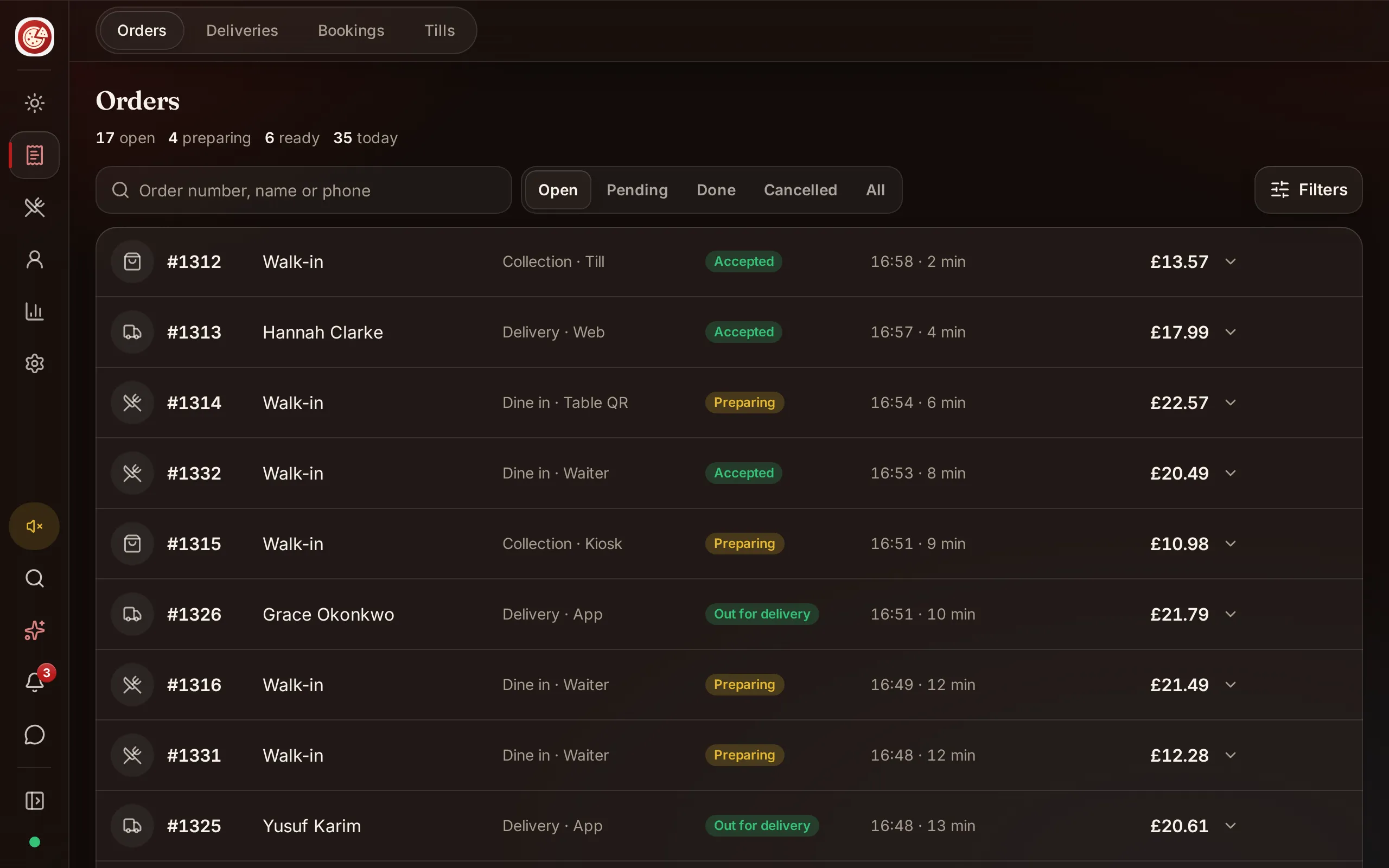
You do not need to be an accountant. You need to know a handful of numbers each week and what to do when they move: net sales, average spend, food cost, labour cost, waste, guest score. See weekly numbers. DineHarbor's reports and the Manager copilot, which can answer supported questions about your own numbers in plain words, are tools for this, but the habit matters more than the tool.
Leading people
People work harder for managers they trust. That comes from small things done consistently: you keep promises, you say thank you, you give feedback early and in private, you treat everyone the same, you do not ask the team to do something you would not do. See managing conflict in the kitchen.
Delegation
You cannot do everything. List your weekly tasks, and split them into three groups: only you can do it (hiring decisions, budgets, discipline), someone else can do it with training (ordering, rota drafts, daily checks) and someone else should do it now (cleaning checks, stock counts). Delegate the second and third groups, explain what good looks like and check the first few times. See opening and closing checklists.
Problem solving
Most problems repeat. When one happens a second time, write the fix on a card. When a third problem arrives, ask what in the process allows it.
A week in the job
A made up but realistic shape for a mid sized restaurant manager:
| Day | Focus |
|---|---|
| Monday | Review last week's numbers, ordering for the week, draft the rota |
| Tuesday | Staff meeting or training session, supplier visit, stock count |
| Wednesday | Admin: payroll prep, invoices, maintenance requests |
| Thursday | Walk the floor in service, observe, coach |
| Friday | Peak service, present and visible, no admin |
| Saturday | Peak service, handle problems |
| Sunday | Close the week, reconcile, plan the next |
Block the admin, protect it and treat it as an appointment. If it slips every week, something else is wrong, usually that you are covering shifts.
Look after yourself
Managers can burn out because the job has no natural end. A few protections:
- Two days off in a row, planned and defended.
- A deputy who can run a service so you can be away.
- One owner for every task, even if the owner is you for now.
- A stop time for messages on your day off.
- A person to talk to, such as another manager, an owner or a mentor.
The owner has a role too: to give clear targets, enough budget to staff the shifts and a way to say "this is too much".
Mistakes new managers make
- Trying to stay everyone's friend. Be kind and fair, not a friend who cannot say no.
- Fixing problems by doing the work yourself.
- Avoiding difficult conversations until a small thing becomes a large one.
- Changing the rules every week.
- Ignoring the numbers until the accountant calls.
- Not asking the team. The person at the dish pit knows what slows the kitchen.
Growing into the role
If you are a supervisor aiming for manager, build a plan with your owner or area manager:
- Learn the numbers by building the weekly report yourself.
- Take over a task such as ordering or the rota, and own it for three months.
- Train someone on your current job, so you have a successor.
- Handle complaints with guidance, then alone.
- Complete the safety training your area needs, such as food safety and first aid.
- Ask for feedback every quarter, and write down your goals.
If you are an owner hiring a manager, write a clear job description, a thirty, sixty and ninety day plan and a list of the numbers you will review together each week.
Sources
- US Bureau of Labor Statistics, Occupational Outlook Handbook: Food Service Managers, figures as of May 2025 data and 2025 to 2035 projections, read in October 2026.
- Your national labour statistics office and local job listings for the pay and requirements in your country.
Want your key numbers in front of you every day? Start the 30 day free trial with no card needed.
Questions and answers
What does a restaurant manager do?
According to the US Bureau of Labor Statistics, food service managers hire, train and sometimes dismiss staff, order food and supplies, oversee food preparation, inspect equipment and work areas, make sure staff follow health and safety standards, deal with complaints, schedule staff and manage budgets and payroll records.
What qualifications do I need to become a restaurant manager?
The BLS says employers in the US typically look for a high school diploma plus several years of food service experience, often as a cook, server or supervisor. Some states and localities require food safety certification. Requirements differ elsewhere.
How much does a restaurant manager earn?
BLS reports median pay for US food service managers of 69,390 dollars a year (33.36 dollars an hour) in May 2025. Pay varies widely by country, city, size and type of business.
What is the hardest part of the job?
Often it is time and people: schedules that include evenings, weekends and holidays, and the need to keep a team motivated while handling complaints, shortages and numbers at the same time.
How do I move from supervisor to manager?
Learn the numbers (sales, food cost, labour), take over rotas and ordering, train others, handle complaints and ask for a development plan with your owner or area manager.
See it in DineHarbor
About the author
Editorial team
The DineHarbor team writes this blog for restaurant owners and managers. Every article is checked against the product before it is published, so what we describe is what the software does.
All articles by DineHarbor team