

Great Restaurant Service Basics
The service basics guests notice: greeting, pace, order taking, allergy questions, checking back, handling mistakes, paying, and how to train and measure.
Updated 7 min read
On this page
Key takeaways
- Guests remember a few moments: the greeting, how quickly they were looked after, how a problem was handled and how the meal ended.
- Write your service standards as a short list of observable actions, not vague values.
- Servers should answer allergy questions from your written information, and say 'I will check' when unsure.
- Train by showing, practising and giving feedback on the floor, and measure what guests actually say.
In short: great service is a handful of habits done every time. Welcome people quickly, take the order accurately, keep the pace right, check back at the right moment, answer allergy questions honestly, fix mistakes without drama and end the meal well. Write the standards as actions the team can see, train them on the floor and measure the results.
About 8 minutes to read. General information. Standards differ by concept: a fast casual counter and a tasting menu need different things.
Guests often talk about how a meal felt: welcomed, looked after, unhurried. They also remember what went wrong and how it was handled. Service is one of the cheapest parts of the experience to improve.
The US Bureau of Labor Statistics lists the core duties of waiters and waitresses as greeting customers, explaining specials and answering menu questions, taking food and drink orders and sending them to the kitchen, carrying food and drinks to tables and checking on customers during the meal, clearing tables, preparing itemised checks and taking payment, setting up and restocking service areas, and verifying customers' ages where alcohol is sold. Those are the moments. The difference between acceptable and great is how you do them.
Define your standards
Vague values ("warm, professional service") do not train anybody. Turn them into a short list of observable actions. For a casual restaurant a first draft might be:
- Every guest is acknowledged within one minute of arriving, even if only with eye contact and "I will be right with you".
- Menus and water are on the table within two minutes of sitting down.
- Drinks are taken within five minutes.
- The server asks about allergies before taking the food order.
- Food reaches the table together for each course.
- The server checks back within two minutes of the food arriving.
- Plates are cleared when everybody has finished.
- The bill is brought promptly when asked, or offered when it is clear the guests are done.
- Every guest is thanked on the way out.
These numbers are examples. Choose your own, observe a few services and adjust. Write them on a single page and put it where the team sees it.
The guest journey, moment by moment
Arrival
The first ten seconds count. A host or the nearest server looks up, smiles and speaks. If you are busy, say "Good evening, I will be with you in a moment". Never let guests stand at an empty host stand. If there is a wait, give an honest quote. See waiting lists and walk ins.
Seating
Show the table and ask whether it is fine. Offer a choice of seat if you can. Hand over menus and mention anything the guest needs to know: the specials, what is sold out and how ordering works. If your restaurant uses a QR menu or self order, show how it works rather than assuming guests know. See QR table ordering.
Drinks and the first conversation
Offer drinks quickly, because guests who have a drink are patient. Ask about allergies and dietary needs early. Mention that the kitchen can adapt dishes where it can and is honest where it cannot.
Taking the order
- Know the menu. Taste the dishes, know what is in them and how they are cooked. See menu design and descriptions.
- Recommend honestly. Suggest a dish you like, say why, and offer options at different prices. See upselling without pushing.
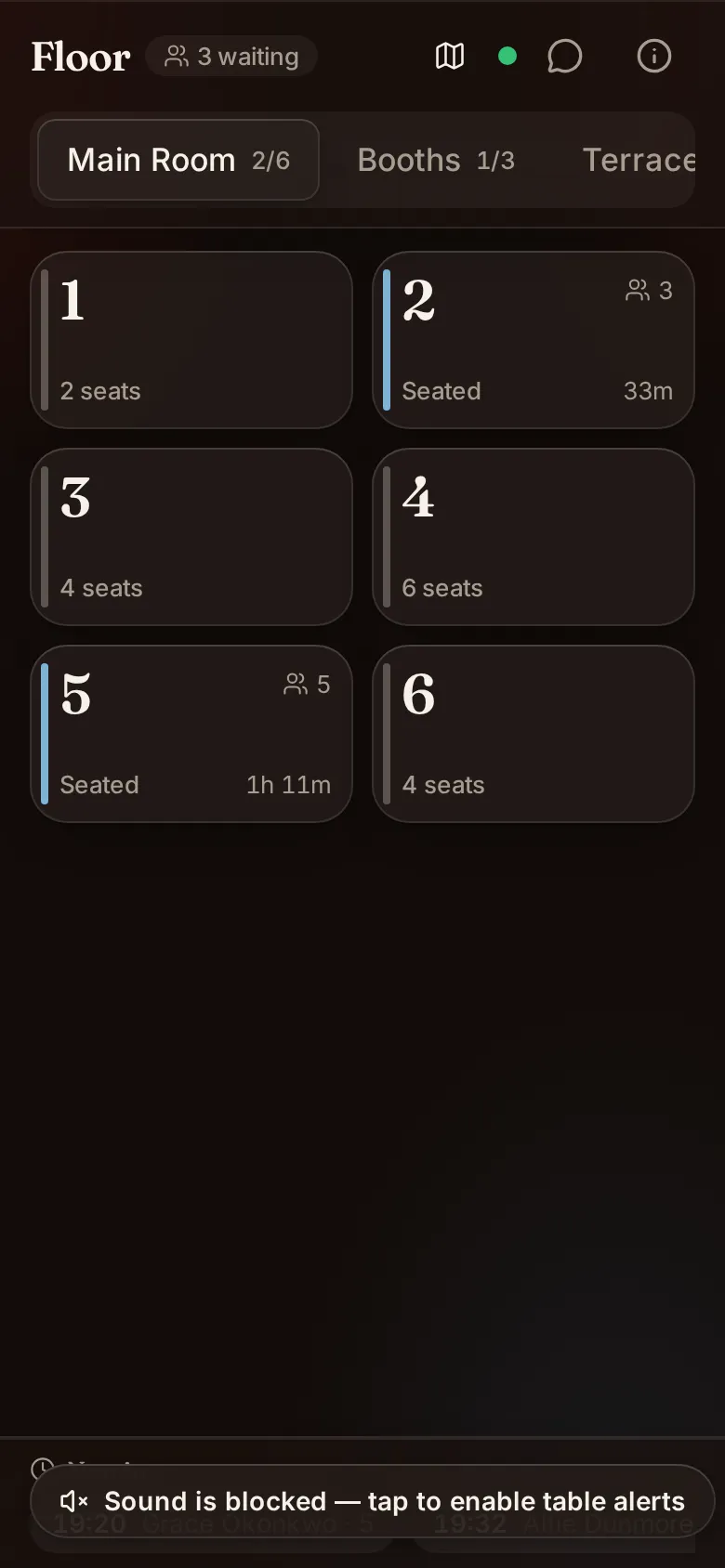
- Repeat the order back if the table is large, or use a handheld to send it straight to the kitchen. DineHarbor's waiter handheld lets servers take orders at the table.
- Flag every allergy on the order and tell the kitchen aloud.
- Set expectations: "The kitchen is busy, the mains will be about twenty five minutes."
Allergy and dietary questions
This is where service becomes safety. Use your written allergen information as the source of truth, never memory. Listen to exactly what the guest cannot eat, tell the kitchen, and bring the dish yourself so you can say what it is. If you do not know, say so. The UK Food Standards Agency expects written allergen information to be backed up by a conversation with the customer, and that is a good rule anywhere. See allergen training for staff.
During the meal
- Pace the courses to the table. A table that is talking does not need the main course in six minutes.
- Check back within a couple of minutes of the food arriving, ask a specific question ("How is the lamb?") rather than "Is everything okay?" and be ready to act.
- Refill drinks before they are empty and offer another round.
- Keep the table tidy: crumbs, empty plates and used napkins.
- Notice body language. A guest looking around wants attention. A guest leaning in wants to talk.
Dessert and the end
Offer dessert and coffee naturally, with the menu. When the guests slow down and look for you, bring the bill promptly. Process payment quickly and return the card or change without a sigh. Thank guests by name if you know it. Tips and service charge are covered in tips and service charges.
The goodbye
A warm goodbye is often the last thing a guest remembers. Hold the door, say "see you again", and clear the table straight away for the next party.
When things go wrong
Mistakes happen: a wrong dish, a long wait, a spill, a lost booking. Guests mostly judge the recovery.
- Notice quickly. Scan your tables every minute or so.
- Apologise sincerely and without excuses.
- Fix it fast: replace the dish, offer a drink, speak to the manager.
- Tell the guest what is happening and when.
- Follow your policy on compensation, and let the manager decide on anything beyond a small gesture.
- Tell the kitchen and the manager, so the cause can be fixed.
- Follow up at the end of the meal.
See reviews and complaints for what to do when the problem reaches the public.
Team habits that raise standards
- Pre service briefing: bookings, specials, sold out items, allergies, who is on which section, and one focus for tonight, such as "check back within two minutes".
- Teamwork: whoever is nearest helps, regardless of section.
- Silent signals: agree simple hand signals or messages for "need help", "table ready" and "allergy".
- Clear sections so every table has a name behind it. See rota and sections.
- A tidy floor and station make everything faster.
- Respect between kitchen and floor. See managing conflict.
Train it
- Show it. New servers watch a good server for a whole shift.
- Practise it. Role play the greeting, the allergy question and the complaint.
- Give feedback. Short, specific, same day: "You checked back quickly at table six, nicely done. At table nine the guests waited for the bill."
- Use a checklist with the standards and have the manager observe.
- Repeat it. Once a week, revisit one standard in the briefing.
See staff training and the onboarding checklist.
Measure it
You cannot improve what you do not see. Watch:
- Time to greeting, to drinks and to first course, by sampling a few tables each shift.
- Order accuracy: remakes and comps for errors.
- Complaints and compliments per hundred covers.
- Review comments that mention service. See feedback surveys.
- Table turn times and wait times at the door.
- Staff retention: happy servers give better service. See staff retention.
Review the numbers with the team, not to blame but to learn.
Common mistakes
- Standards that exist only as values on a wall.
- Hiding when the room is busy.
- Reading from a script in a flat voice.
- Guessing at allergen answers.
- Defending the restaurant when a guest complains.
- Clearing plates while some guests are still eating.
- Training once and never again.
A checklist
- Write nine or ten standards as observable actions.
- Greet fast, even when busy.
- Ask about allergies before the food order and flag them.
- Pace courses to the table and check back with a specific question.
- Fix mistakes quickly and tell the manager.
- Make the goodbye as warm as the hello.
- Train by showing, practising and feedback.
- Measure and review weekly.
Sources
- US Bureau of Labor Statistics, Occupational Outlook Handbook: Waiters and Waitresses, read in October 2026.
- UK Food Standards Agency, allergen information for non-prepacked foods: best practice.
Want servers to send orders from the table? Start the 30 day free trial with no card needed.
Questions and answers
What makes service great in a restaurant?
Guests often value being welcomed quickly, being looked after at the right pace, accurate orders, honest answers and a graceful way of handling mistakes. Great service is consistent more than it is clever.
How soon should guests be greeted?
There is no universal number. Decide your own standard, such as acknowledging guests within a minute of arrival and taking drinks orders within a few minutes of seating, then measure it.
What should a server do when they do not know an answer about allergens?
Say so honestly and check the written information or ask the kitchen. Never guess. See your allergen procedure.
How do I handle a mistake?
Notice it quickly, apologise sincerely, fix it fast and tell the guest what you are doing. Ask the manager before offering compensation, according to your policy.
How do I train service standards?
Write them as a short checklist, show them in action, let new servers practise with a buddy, give feedback on real shifts and revisit the standards in regular team briefings.
See it in DineHarbor
About the author
Editorial team
The DineHarbor team writes this blog for restaurant owners and managers. Every article is checked against the product before it is published, so what we describe is what the software does.
All articles by DineHarbor team