

Commission Free Online Ordering
What commission free online ordering really costs a restaurant, with a worked example in pounds, dollars and euros, and how to move customers over.
9 min read

On this page
Key takeaways
- Commission free means no percentage of each order goes to the ordering software. You still pay a card fee, a small subscription, packaging and delivery.
- In our example, 300 orders a month at a marketplace rate of 30 percent cost about 2,250 pounds. Moving half of them to an own site saves about 960 pounds a month after every new cost.
- Only move customers you can reach legitimately: your own regulars, your own flyers, your Google profile. Do not use marketplace customer data against its contract.
- Prices on this page were checked on the vendors' own pages on 1 November 2026. Rates change, so check again before you decide.
In short: commission free online ordering means customers order from your own website or app, pay you directly, and nobody takes a percentage of the basket. It is not free: you still pay card processing fees, a software subscription, packaging and delivery. In the worked example below, a takeaway with 300 orders a month that moves half of them from a marketplace to its own site keeps roughly 960 pounds, 1,070 dollars or 1,070 euros a month more. The sum changes with your rate, your basket and how many customers actually switch.
This guide replaces two shorter posts we used to publish on the same subject. It brings together what was useful in them: how to read your marketplace statement, what direct ordering costs, and how to bring customers over without losing them.
What a marketplace charges
Delivery marketplaces charge a percentage of the order, and the percentage depends on the country, the contract and what service you pick. One platform publishes its UK rates openly. Uber Eats shows on its UK merchant page 30 percent when Uber delivers the order (33 percent for Uber One members), 13 percent when the restaurant delivers itself, 13 percent for collection, and a one off activation fee of 650 pounds excluding VAT, with the percentages shown excluding VAT. We read that page on 1 November 2026.
We could not read a rate card on the Deliveroo and Just Eat merchant pages, so we do not quote a number for them. Ask each platform for its current rate in writing. Our comparison of Deliveroo, Just Eat and Uber Eats fees shows how to turn any rate you are offered into profit per order.
Two things to check on every statement:
- Whether the percentage is charged on the food only, or also on delivery, service fees and tips.
- Whether promotions, advertising and refunds are charged to you on top.
The only reliable number is the one in your own agreement and statements. Take ten ordinary orders from last month and work out what you were actually left with after every deduction.
What commission free really costs
Taking orders yourself changes the shape of your costs. It does not remove them. These are the lines to count.
1. Card processing fees. The customer pays by card on your site and your payment provider takes a fee. As an example of a published rate, Stripe's UK page shows 1.5 percent plus 20 pence for standard UK cards and 2.8 percent plus 20 pence for premium UK cards, 2.5 percent plus 20 pence for European cards, and 3.15 percent plus 20 pence for other international cards (checked 1 November 2026). Its Ireland page shows 1.5 percent plus 0.25 euro for standard European cards. We could not read Stripe's US rate on the page, so the dollar example below uses a stated assumption. Whichever provider you choose, read its own page. Our guide to card payment fees explains the difference between standard, premium and international cards.
2. The platform fee. This is the ordering software. DineHarbor's Restaurant plan, which gives you your own ordering site and domain with 2,500 online orders a month included and no commission from us, is 40 pounds, 50 dollars or 45 euros a month per location. There is a free Menu plan with up to 30 online orders a month, and a 30 day free trial with no card needed. See the current figures on the pricing page, because plans can change. Other vendors charge differently, and some add a percentage on top of a subscription, so ask the question directly: does the software take a share of each order?
3. Marketing. A direct channel does not fill itself. You will spend a little on printing flyers and cards for your bags, maybe on a small offer for a first direct order, and some time on your Google profile and social pages. In our example we budget a modest monthly amount. Your real figure may be lower or higher.
4. Delivery. If you deliver, the cost moves from the marketplace's driver to yours: wages or per delivery pay, insurance, fuel and the time someone spends on dispatch. If you cannot deliver profitably yet, start with collection only. Our guides to running your own delivery and to takeaway and delivery profit cover this in more detail.
5. Packaging and refunds. These exist on every channel, so they rarely change the comparison, but write them down so that the two columns match.
A worked example in pounds, dollars and euros
This is arithmetic with round numbers, not a claim about any restaurant or marketplace. Suppose a takeaway receives 300 orders a month through marketplace apps, all at a 30 percent rate, which is the Uber Eats delivery rate published on its UK page. The average basket is 25 pounds, 30 dollars or 28 euros. It then opens its own ordering site and moves half of its customers, 150 orders, over to it. The other 150 stay on the apps.
Assumptions: card fees of 1.5 percent plus 20 pence (pounds) and 1.5 percent plus 0.25 euro (euros) from the Stripe pages above, and for dollars an assumed 2.9 percent plus 30 cents because we could not read the US page, so check yours. Software at the DineHarbor Restaurant plan price. A marketing allowance of 60 pounds, 75 dollars or 70 euros a month.
| Monthly | Pounds | Dollars | Euros |
|---|---|---|---|
| Basket | £25 | $30 | €28 |
| All 300 orders on apps at 30% | £2,250.00 | $2,700.00 | €2,520.00 |
| 150 orders left on apps at 30% | £1,125.00 | $1,350.00 | €1,260.00 |
| Card fees on 150 direct orders | £86.25 | $175.50 | €100.50 |
| Ordering software | £40.00 | $50.00 | €45.00 |
| Marketing allowance | £60.00 | $75.00 | €70.00 |
| Total cost after moving half | £1,311.25 | $1,650.50 | €1,475.50 |
| Kept each month | £938.75 | $1,049.50 | €1,044.50 |
In this example the restaurant keeps about 940 pounds a month, which is about 11,300 pounds a year. If all 300 orders moved, the card fees would double and the saving would be larger, but very few restaurants move everyone, and some marketplace customers will never leave the app they like. Move 50 orders instead of 150 and the saving is a third of the figure above. The method is what matters: put your own basket, rate and order count into the table.
How to move customers over without losing them
You are not trying to push customers away from the apps. You are giving people who already like your food a better way to order. Here is an order that works, from the cheapest steps to the more ambitious ones.
1. Make the direct route as easy as the app
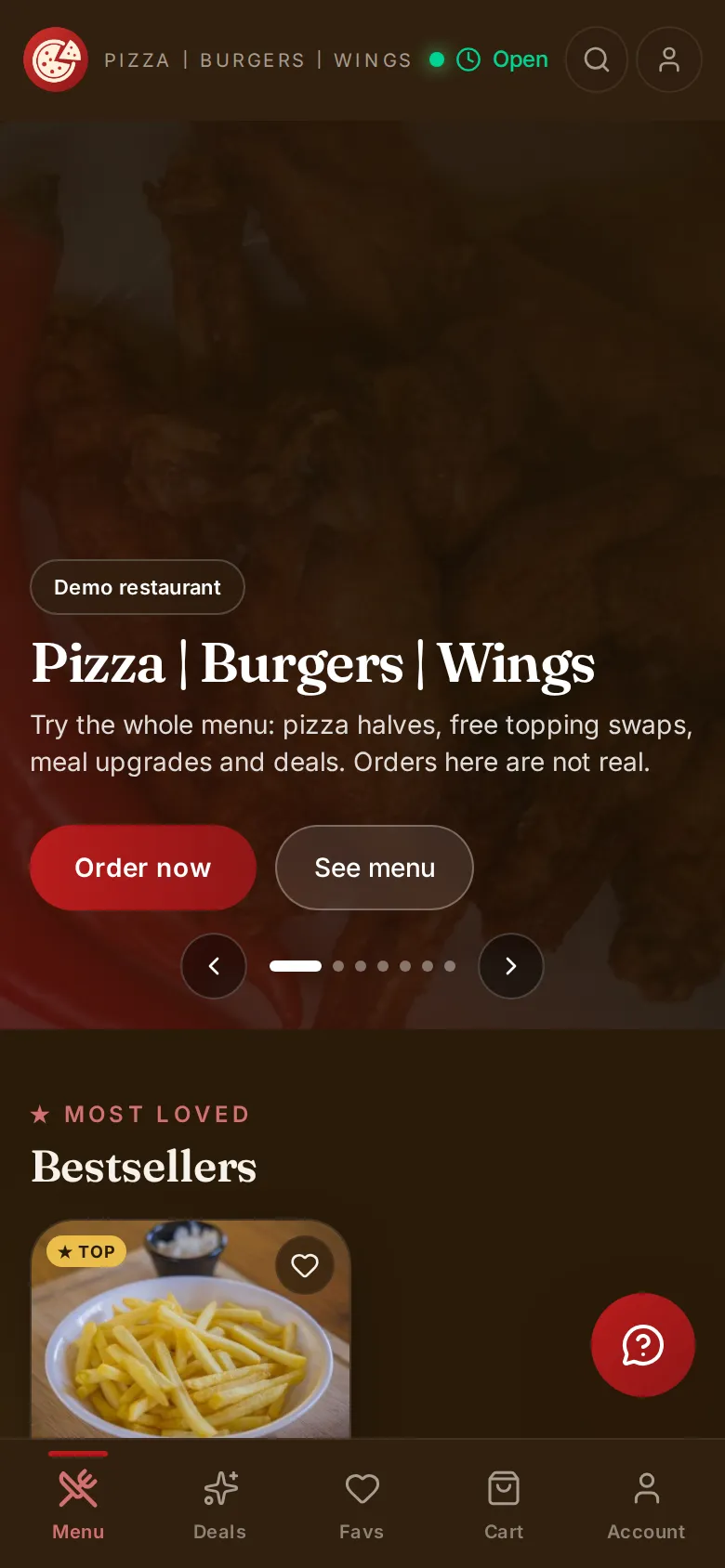
Customers will not give up a familiar app for a slow website. Open your ordering site on a phone 360 pixels wide, place a real test order for collection and one for delivery, and fix whatever annoys you. It should show the full menu with photos, options and allergens, take a card or wallet payment, and tell the customer when the food will be ready. Read how to turn a paper menu into an online menu if the menu is the slow part.
2. Put the link where hungry people already look
Link your ordering page from your Google profile, your website, your social pages, your receipts and the counter. Our guide to the Google Business Profile for restaurants shows how to add an ordering link. Use a short, readable address and a QR code, because not everyone wants to scan.
3. Put a card in every direct bag
For orders you pack from your own channel, add a card that says how to order direct next time, and what the guest gains: a small first order offer, loyalty points or easier reordering. A repeat customer who orders from you costs nothing extra to win back.
4. Reward the second order
Pick one rule that staff can explain in a sentence, such as points per pound or a stamp card. Our loyalty programme guide compares the options. Avoid a page of exceptions.
5. Respect the marketplace's contract
Do not use customer details that a marketplace gave you in ways its terms do not allow, and read the contract before you put leaflets in marketplace bags. Build your own list from orders placed on your own site, with clear privacy information and marketing consent where the law requires it. Direct ordering wins on convenience and a fair reason to switch, not on tricks.
6. Move in stages and measure
Keep your marketplace listing live while the direct route proves itself. Track direct orders, average basket, refunds and repeat guests each month. When regulars use your site without being asked, decide whether paid marketplace visibility still earns its place. The goal is a mix: apps for discovery, your own site for the people who already want your food.
Where DineHarbor fits
DineHarbor gives a restaurant its own online ordering site with no commission on orders. The same orders arrive on the kitchen screen and the till, so staff handle direct and walk in orders in one place. You can try it for 30 days free, and the pricing page lists the plans. Card fees still go to your own payment provider, and delivery costs are yours. If you build sites for restaurants as an agency or consultant, see the partners page, where you can refer restaurants and earn a share.
If you are starting from nothing, read our seven day plan: how to start online ordering for your restaurant.
Questions owners ask
Is it legal to ask customers to order direct? You can promote your own ordering service. Read the marketplace contract about messages in its orders and use of its customer data.
Do I lose access to delivery drivers? You can run your own drivers with delivery zones and live tracking, or keep using marketplace delivery for some orders. Compare the full cost of each.
Do customers need an app? Not with a browser based ordering site: they open the menu on their phone and order.
Sources and dates
Prices were checked on the vendors' own pages on 1 November 2026: Uber Eats merchant pricing, UK, Stripe pricing, UK and Stripe pricing, Ireland. Deliveroo, Just Eat and Stripe US rates could not be read, so they are not quoted: check on their sites. The worked example is illustrative arithmetic.
Questions and answers
Is commission free online ordering really free?
No. You still pay for the ordering software, card processing fees, packaging and delivery. What goes away is the percentage that a marketplace keeps from every order. The cost becomes a small fixed fee plus a card fee, instead of a large share of each basket.
How much can a restaurant save by taking orders on its own site?
It depends on how many customers move over. In the worked example in this article, a takeaway with 300 orders a month that moves half of them to its own site keeps roughly 960 pounds, 1,070 dollars or 1,070 euros more each month. Run the same sum with your own statements.
Can I stay on delivery apps and also take direct orders?
Yes, and most restaurants do. Keep the apps for new customers who find you there, and make your own site the easiest way for people who already know you to reorder. Read each marketplace contract before you put messages in its orders.
Who pays the card fee on a direct order?
The restaurant pays its own payment provider. The fee is a percentage plus a small fixed amount per payment, so it is far lower than a marketplace commission, but it is not zero.
Will customers really order from my website?
They will if it is quick on a phone, shows the whole menu with photos and prices, and is easy to find from your Google profile, receipts and packaging. Most of the work is making the direct route the obvious one.
See it in DineHarbor
About the author
Editorial team
The DineHarbor team writes this blog for restaurant owners and managers. Every article is checked against the product before it is published, so what we describe is what the software does.
All articles by DineHarbor team

