

Restaurant Sustainability That Pays
Practical sustainability for restaurants: measure food waste, buy and cook smarter, cut energy and packaging, donate surplus and avoid greenwashing.
Updated 8 min read
On this page
Key takeaways
- The biggest sustainability win in most restaurants is also a cost saving: wasting less food.
- WRAP's approach for hospitality is Target, Measure, Act, and it offers free resources for UK food service businesses.
- The EPA food recovery hierarchy ranks actions: prevent waste first, then feed people, then animals, then industrial uses, then compost, and landfill last.
- Tell guests only what you can prove, and measure before you claim.
In short: start with food waste, because it saves money and the planet at once. Measure it, find the main causes, change purchasing, prep and menus, donate surplus safely, then look at energy, water and packaging. Be specific and honest when you talk to guests.
About 8 minutes to read. General information. Rules on waste, packaging and advertising differ by country: check your local authority.
Sustainability can sound like a lot of expensive gestures: certificates, paper straws and a green logo. For a restaurant, the useful version is simpler. Waste less, buy better, use less energy and water, send less to landfill, and say what you did. Most of it lowers costs.
Start with food waste
Food waste is where sustainability and profit meet. Every kilo thrown away is a kilo you paid for, prepared and sometimes cooked.
WRAP, the UK charity, runs Guardians of Grub, a campaign for hospitality and food service. It recommends WRAP's Target, Measure, Act approach as the foundation, offers free resources such as posters, how to guides and a calculator to record changes, and aims for a 50 percent reduction in food waste by 2030. WRAP cites an average return on investment of 1 to 14 across a range of hospitality and food service businesses, which is a sector wide average and not a promise for any single restaurant. The campaign is aimed at everyone from fine dining to local pubs. See also our guide to reducing food waste.
Target, Measure, Act
- Target. Choose a goal, such as "cut waste by a quarter in six months".
- Measure. Weigh or record waste for two weeks. Separate prep waste, spoilage, plate waste and returns.
- Act. Fix the biggest cause first and measure again.
Measure it simply
A bin liner, a scale and a sheet are enough. Record:
- date, shift and the main reason (spoiled, trimmed, overproduced, returned, plate waste);
- weight, and the cost if you can estimate it;
- the dish or ingredient.
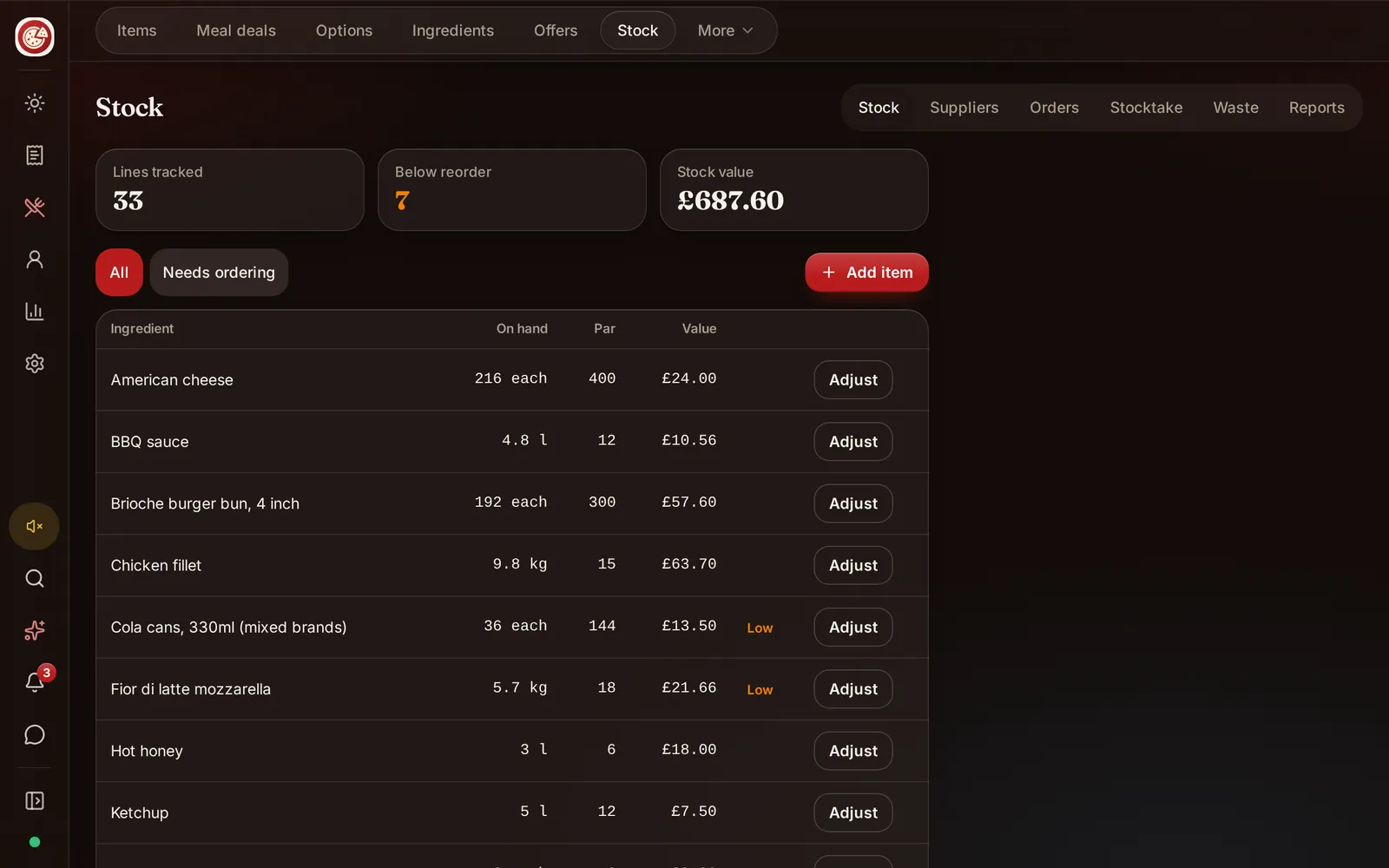
Look for the top three causes. A tool helps if you have stock records: DineHarbor's inventory and stock and reports help you keep stock and sales numbers together, but the weighing habit is yours. See stock control and FIFO and storage.
Typical causes and fixes
| Cause | Fix |
|---|---|
| Over ordering | Order to a par level based on sales, not habit. See suppliers and ordering |
| Spoilage | First in, first out, labels, temperature checks. See FIFO and storage |
| Over prep | Prep to forecast and re prep during service |
| Big portions | Check portion sizes against the recipe card; offer a smaller size |
| Plate waste | Ask guests about what is left, adjust the dish or the sides |
| Trim waste | Use stems, peels and bones for stocks, sauces and staff meals |
| Menu complexity | A shorter menu with shared ingredients. See menu engineering |
| Mistakes | Repeat orders back, and use a kitchen display. See kitchen display systems |
The food recovery hierarchy
The US Environmental Protection Agency ranks what to do with food, from most to least preferred:
- Source reduction: stop creating the waste in the first place.
- Feed hungry people: donate unspoiled, safe food.
- Feed animals: where local rules allow, send scraps to animal feed.
- Industrial uses: such as turning fats into energy.
- Composting.
- Landfill or incineration: the last choice.
The EPA pages behind this hierarchy were last seen as an archived January 2021 version, so check the current one, and rules about each tier vary by country. The principle is clear and useful: prevention beats donation beats composting beats the bin.
Donating surplus
If you plan to give food to charities, community fridges or apps:
- check your local rules and your food safety plan on what you can donate, how you store and label it and how long it can be held;
- agree in writing with the receiving organisation what they accept and when;
- keep food at safe temperatures until handover, and record it. See cooling and reheating and temperature logs;
- label with ingredients and allergens. See allergen training;
- do not donate food that has been served to guests unless the law and your plan allow it.
Ask your local authority about liability and guidance.
Buy better
- Seasonal and local where it is cheaper and fresher. See seasonal menu planning.
- Fewer, better suppliers you can talk to, with clear delivery days.
- Ask for less packaging and reusable crates from suppliers.
- Use the whole animal or plant and teach the team to cook with trim.
- Check certifications only if they matter to your guests and you can verify them. Certifications cost money and have conditions.
- Plan menus around what you can use up, with a daily special that clears stock safely.
Cook and serve smarter
- Batch to demand and cook to order where it makes sense.
- Offer half portions and flexible sides.
- Use a "specials" board for ingredients near their use by date, while staying within food safety rules.
- Turn trim into staff meals, stocks, pickles and sauces.
- Offer a doggy bag or a takeaway box for leftovers if your food safety plan allows.
- Watch the buffet: it is the highest waste format. Use smaller pans and refill more often.
Energy and water
You do not need an audit to start. Walk through at closing and look.
- Switch off equipment that does not need to run: grills, extractors, lights, ovens, the dishwasher heater.
- Keep fridge and freezer seals clean and doors closed. Do not put hot food straight in, which makes the compressor work harder. See cooling and reheating.
- Service extraction, refrigeration and ovens as the maker suggests. Clean equipment works better.
- Use lids, the right pan size and the right burner size.
- Fix leaks and dripping taps.
- Run the dishwasher full and scrape, not rinse, plates.
- Switch to efficient lighting.
- Check your electricity and gas bills monthly, and look for a change. Your supplier may offer a free review.
When you buy new equipment, compare running cost as well as purchase price. See restaurant equipment list.
Packaging and takeaway
- Use as little as the food needs. Right sized boxes, no unnecessary extras.
- Ask, do not assume, about cutlery, napkins and sauces.
- Check local rules on single use plastics, recycling and compostable packaging. Rules and collection systems differ widely by place, and a "compostable" box is only compostable if the local system accepts it.
- Test any new packaging with a real order: does the food arrive hot and intact? A box that fails costs more than one that works. See takeaway packaging.
- Offer a reusable container option if you have a way to manage it hygienically.
Waste sorting
Set up bins for general waste, recycling and food waste (where a collection exists), with clear pictures. Put them where the work is, not in the yard. Brief the team at induction. Check your local waste rules and your collection contract, because business waste rules are specific to each place.
Tell the story honestly
Guests like to hear what you do, but they distrust vague claims.
- Be specific. "We cut food waste by a quarter in 2026 by weighing and changing our prep" is better than "We are eco friendly".
- Use numbers you measured, and say how you measured them.
- Name your suppliers if they agree.
- Do not overclaim. A claim you cannot prove can mislead guests and may break the advertising rules of your country. Check with your advertising authority.
- Say what you are still working on. Honesty builds trust.
- Tell your team first, because they will be asked about it.
See restaurant social media for ways to share the work.
Involve the team
- Explain why, and the savings.
- Ask for ideas: the dish pit sees waste first.
- Share the numbers monthly.
- Celebrate wins, and avoid blame.
- Add the practices to the onboarding checklist and the opening and closing checklists.
Common mistakes
- Starting with packaging and ignoring food waste.
- Buying "green" products without checking local recycling.
- Donating food without a food safety plan.
- Claims that you cannot support.
- Measuring once and never again.
- Leaving the team out.
- Chasing every idea at once.
A checklist
- Weigh and record waste for two weeks.
- Fix the top three causes.
- Order to par levels and use first in, first out.
- Use trim and offer smaller portions.
- Arrange safe donation, where allowed.
- Do an energy and water walk at closing.
- Choose packaging that fits and works locally.
- Tell guests specific, true things.
Sources
- WRAP, Guardians of Grub, UK hospitality and food service food waste campaign, read in October 2026.
- US Environmental Protection Agency, Food Recovery Hierarchy (archived January 2021 snapshot).
- Your local waste authority and advertising authority for the rules where you operate.
Want to see usage and stock in one place? Start the 30 day free trial with no card needed.
Questions and answers
Where should a restaurant start with sustainability?
With food waste. Measure what you throw away for two weeks, find the three biggest causes and fix them. It saves money straight away.
What does WRAP recommend?
WRAP, the UK charity, promotes Target, Measure, Act as a foundation for reducing food waste in hospitality and food service, and its Guardians of Grub campaign offers free resources and a calculator.
What is the food recovery hierarchy?
An EPA ranking of options from most to least preferred: source reduction, feeding hungry people, feeding animals, industrial uses, composting, then landfill or incineration.
Can I say my restaurant is eco friendly?
Only with specific, honest claims you can prove, such as the percentage of food waste reduced or the supplier you use. Vague green claims can mislead guests and may break advertising rules in your country.
Is sustainable packaging more expensive?
Sometimes. Compare the full cost, including waste and local rules, and use only as much packaging as the food needs. Fewer items, sized well, often cost less.
See it in DineHarbor
About the author
Editorial team
The DineHarbor team writes this blog for restaurant owners and managers. Every article is checked against the product before it is published, so what we describe is what the software does.
All articles by DineHarbor team