

Restaurant Events and Private Dining
How to run private dining and events: rooms, packages, pricing, minimum spend, booking terms, licences, allergens, staffing, run sheets and promotion.
Updated 8 min read
On this page
Key takeaways
- Private dining and events fill quiet nights and raise average spend, but only if the offer, price and terms are clear.
- Offer two or three set packages with a minimum spend rather than a blank page, and write the booking terms down.
- Check licensing early: in England and Wales a Temporary Event Notice may be needed for licensable activities on unlicensed premises, with fixed lead times and limits.
- DineHarbor does not collect deposits, so any deposit for an event is handled outside the product.
In short: decide what you can offer well, such as a private room, a semi private area or a full buyout. Build two or three clear packages with a price per head or a minimum spend, write simple terms, check licensing early and brief the team in writing. Promote it to the groups that already search for it.
About 9 minutes to read. General information, not legal advice. Licensing and tax rules differ by place: check your local authority.
A table of eight on a Tuesday is a nice booking. A table of thirty on a quiet Monday is a month's worth of that day. Private dining and events turn space that is empty on certain nights into planned, higher value business: birthdays, anniversaries, company dinners, wedding parties, wakes, launches and tastings.
They also cause the most stress in a restaurant if they are improvised. This guide shows how to build an offer that is easy to sell, easy to deliver and fair to guests and the team.
Decide what you can deliver
Start with your space and your kitchen, not with a brochure.
- A private room with a door, a bathroom nearby and its own sound.
- A semi private area such as a mezzanine or a corner that can be screened.
- A section of the main room for a group, reserved for a time.
- A full buyout of the restaurant on a quiet night.
- An offsite or outdoor event, which is catering. See restaurant catering business.
For each, write down capacity seated and standing, access and toilets, power and sound, whether music or a speaker is allowed and the latest finish time. If you serve alcohol, check the licence conditions for the space.
Build packages
Blank pages create long email chains. Offer two or three packages, such as:
| Package | What is included | How it is priced |
|---|---|---|
| Set dinner | Three courses from a short menu, with a welcome drink | Per head, minimum numbers |
| Sharing feast | Dishes to the table, one dessert, tea and coffee | Per head |
| Drinks and canapés | Two hours of canapés and a drinks tab | Per head, with a drinks cap |
| Room only | Space for a set time, guests order from the menu | Minimum spend |
A set menu is easier to cost, prepare and serve. See set menus and lunch deals and menu engineering. Choose dishes that hold well for groups and do not need last minute finishing. Offer dietary alternatives: vegetarian, vegan, and the options you can do safely. See vegan and vegetarian menus and halal and kosher menus.
Price it with real figures
Do the sums before you quote.
- Food and drink cost per head from your recipes. See recipe costing.
- Staff: extra servers, a runner, a bartender and a manager for the event, with their hours including set up and breakdown.
- Opportunity cost: what the space would normally earn at that time.
- Extras: flowers, printing, music, rentals, a cake cut fee if you charge one.
- Fees and tax: payment fees, service charge rules and tax. See card payment fees, tips and service charges and VAT and sales tax.
- Margin to meet your targets.
A minimum spend is a simple way to protect the opportunity cost: if the group spends less, they pay the difference. State clearly what counts towards it and whether service charge and tax are included.
Write the booking terms
A one page document avoids most disputes.
- What is included and what costs extra.
- Numbers: minimum and maximum, and the date by which the final number must be confirmed. Say what happens if it drops.
- Menu choices: when the group must choose, and how dietary needs are collected.
- Payment: when the balance is due and how.
- Deposit and cancellation: whether a deposit applies, what is refundable and by when.
- Timing: arrival, start, last orders and end of the event.
- House rules: decorations, candles, music, outside food and cakes.
- Damage and cleaning.
- Contact on the day: one named person on each side.
- Changes and force majeure.
Ask a local adviser to check the terms, and use plain words. See reducing no shows for the logic behind confirmations.
Licences and safety
Events often involve licensable activities. For example, GOV.UK explains that in England and Wales a Temporary Event Notice (TEN) covers licensable activities such as selling alcohol, entertainment or serving hot food or drink between 11pm and 5am, either on unlicensed premises or when an activity is not covered by your existing licence. Its key limits as of October 2026:
- fewer than 500 people at all times, including staff;
- up to 168 hours;
- the applicant must be at least 18;
- up to 5 notices per person a year (50 with a personal alcohol licence), and up to 15 per premises a year totalling no more than 21 days;
- at least 24 hours between consecutive events;
- apply at least 10 clear working days before the event; a late notice is possible between 9 and 5 clear working days before, with tighter limits;
- the fee is £21, and only the police or environmental health can object.
That page covers England and Wales only. Scotland, Northern Ireland and other countries have their own systems. If you already have a premises licence, your conditions may already cover the event or may limit it, so ask your local licensing authority early. Also think about:
- Capacity and fire safety. More tables and decorations change the risk. See first aid and fire safety.
- Insurance. Check that your cover includes events and guests at the numbers you expect. See insurance.
- Music licences if you play recorded or live music, which may need a licence where you operate: check with your local authority.
- Allergen information for every dish, with written details. See allergen training.
- Noise and neighbours, with a finish time that suits them.
Run it on the day
An event runs on a run sheet, one page for the whole team:
- the time of each step: arrival, drinks, seating, courses, speeches, dessert, last orders, end;
- the number of guests, the layout and the seating plan;
- the menu, with dietary requirements by name and seat;
- the staffing by role;
- the contact for the host;
- any special requests: a cake, flowers, a toast, music.
Hold a short briefing before the event. Reconfirm dietary needs. Set the room an hour early, and check lighting and temperature. Have a manager present throughout.
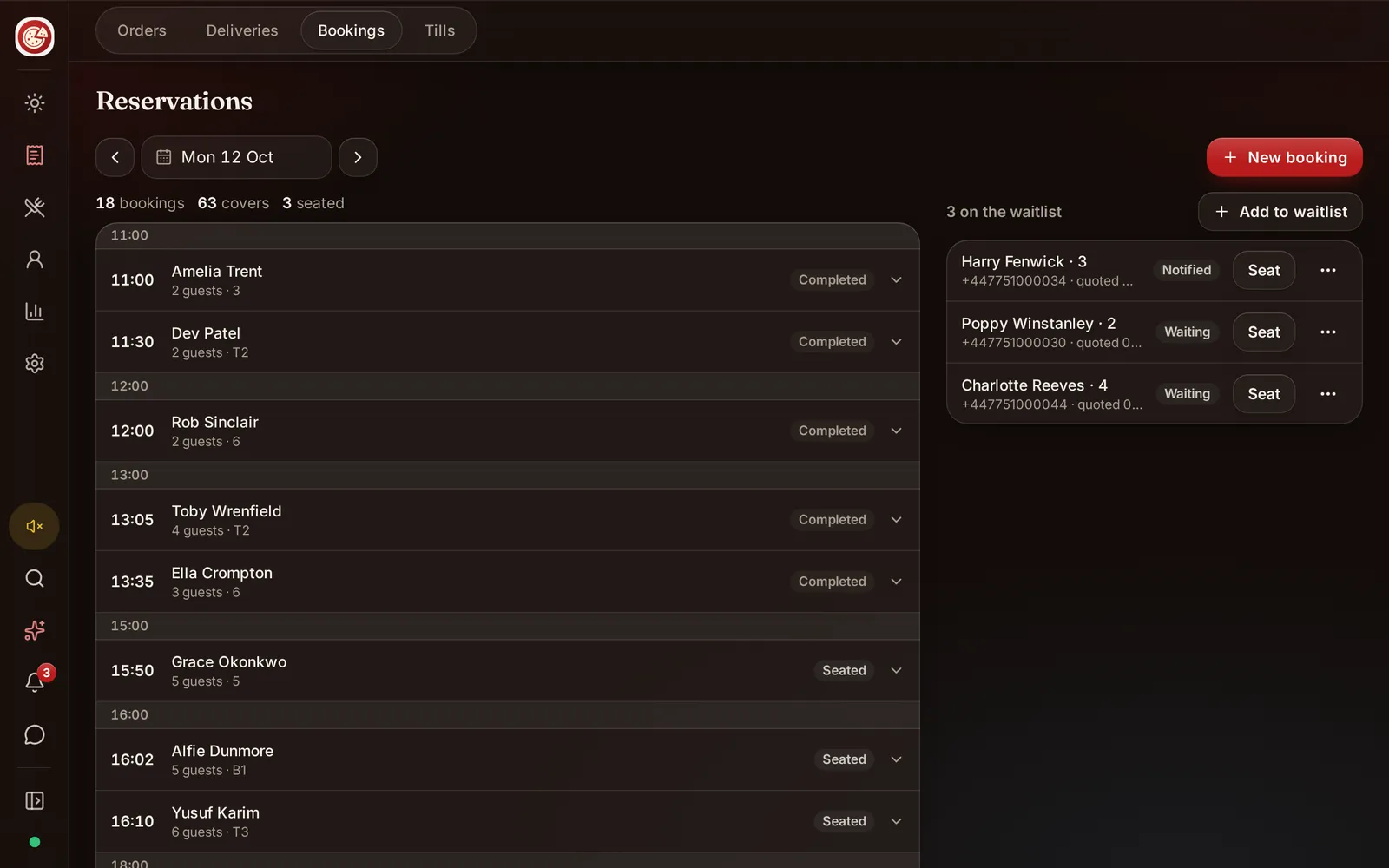
If you take a group booking on the floor plan, mark the tables and the time so the rest of the restaurant is protected. DineHarbor's reservations and floor plan lets you plan bookings against your tables, which helps when a group takes part of the room.
After the event
- Settle the bill promptly and accurately, with a clear breakdown.
- Thank the host the next day and ask for feedback. See feedback surveys.
- Ask for a photo and permission to use it. See restaurant photography.
- Review the numbers: actual cost, time, spend per head, waste and complaints.
- Keep the client details with permission, for next year's booking. See email and SMS marketing.
Promote it
- A dedicated page on your website with the room, the packages, photos and an enquiry form.
- Your Google Business Profile, with photos of the room. See Google Business Profile.
- Local businesses, wedding planners, venues and community groups.
- Past guests who celebrated with you.
- Social media posts with real events, with the host's permission. See restaurant social media.
- Seasonal pushes: spring celebrations, summer parties, the festive season.
Respond to enquiries the same day with a short email: the packages, the dates available and the next step.
Common mistakes
- Quoting before costing.
- No minimum numbers or final number date.
- Forgetting the licence check until a week before.
- Letting an event take the best tables on a busy night.
- Not collecting dietary needs in writing.
- Under staffing the event.
- No run sheet.
A checklist
- Decide the spaces and capacities you can deliver.
- Build two or three packages with prices.
- Cost each one with staff and opportunity cost.
- Write one page of booking terms.
- Check the licence and insurance.
- Collect numbers and dietary needs in writing.
- Prepare a run sheet and brief the team.
- Follow up and review the numbers.
Sources
- GOV.UK, Temporary Event Notice, England and Wales, read in October 2026.
- Your local licensing authority for licences, music and capacity rules where you operate.
Want to plan group bookings against your real tables? Start the 30 day free trial with no card needed.
Questions and answers
How should I price private dining?
Work from cost and capacity: food and drink cost, staff for the event, the sales you would otherwise make in that space at that time, and a margin. Many restaurants use a minimum spend or a set menu price per head. Test it with real figures.
Do I need a licence for an event?
It depends on your existing licence and the activities. In England and Wales, GOV.UK says a Temporary Event Notice is for licensable activities on unlicensed premises or not covered by your licence. Check with your local licensing authority.
How far ahead must a Temporary Event Notice be filed?
GOV.UK says at least 10 clear working days before the event, with a late notice allowed from 9 to 5 clear working days before under tighter limits. Check the current page.
How do I handle allergies at events?
Ask for dietary needs and allergies when the booking is confirmed and again a few days before, record them in writing, brief the kitchen and the servers and label dishes. See your allergen procedure.
Can DineHarbor take a deposit for an event?
No. DineHarbor does not collect deposits. If you require a deposit, agree it in writing and take it by a method outside the product.
See it in DineHarbor
About the author
Editorial team
The DineHarbor team writes this blog for restaurant owners and managers. Every article is checked against the product before it is published, so what we describe is what the software does.
All articles by DineHarbor team