

Cash Handling and Till Discrepancies
How to handle cash in a restaurant: floats, counts, drops, cashing up, what to do when the till is short or over, controls that protect staff and records.
Updated 8 min read
On this page
Key takeaways
- Most till differences come from process gaps such as wrong change, unrecorded paid outs and shared drawers, not from theft.
- Give each person their own drawer or login, count in pairs, and count the same way every day.
- Investigate a difference by following a fixed checklist, and write down the cause so patterns show up.
- Good controls protect honest staff as much as the business, and record keeping rules depend on your country, so ask your accountant.
In short: treat cash like stock. Give every person their own drawer or login, count it the same way every time, keep a float that never changes, move surplus to a safe during service, and write down what you find. When the till is out, use a checklist, not suspicion.
About 8 minutes to read. General information, not legal, tax or employment advice. Check your own country's rules.
Cash is the part of the business that is easiest to lose and hardest to trace. A busy Friday, three people sharing one drawer, a delivery paid out of the till, and at 1am nobody can say why the till is 30 short. It is rarely theft. It is usually a gap in the process.
Fixing it is cheap: a few routines, a written count and a manager who looks at the same sheet every day.
Why differences happen
When a till is short or over, the usual causes are boring:
- Wrong change. Especially on busy shifts or with foreign notes.
- Paid outs not recorded: a delivery driver, a supplier, a tip, a petty cash purchase.
- Voids and refunds entered but cash not handed back, or handed back but not entered.
- Wrong tender chosen: cash recorded as card, or card as cash.
- Shared drawers, so nobody owns the number.
- Float changes that were not written down.
- Counting mistakes, especially at the end of a long night.
- Theft, which is real but should be the last conclusion, not the first.
Notice that nearly all of these are fixed by process.
Set the float
The float is the cash you start each shift with. Keep it the same every time, in set denominations, so that a shift starts and ends with a known number.
- Decide the amount for each till or drawer (for example enough small notes and coins to give change to your typical order).
- Write the denominations: how many of each coin and note.
- Count it in at the start, sign it, and have a second person check it when a new person takes over.
- Keep the float, not the day's sales, in the drawer at close. Bank or safe the rest.
One drawer, one person
Shared drawers are the biggest single cause of unexplained differences. When two people use the same one, either can be right and nobody can be sure.
- Give each cashier a drawer or a login for their shift.
- If you use a POS, make sure each person has their own sign in so that sales, voids and refunds carry a name. See roles and permissions.
- Do not let a drawer change hands in the middle of service without a count and two signatures.
- Lock the drawer when the person steps away.
During service
- Make drops. When the drawer reaches the level you set, drop the extra notes into a safe or a drop box, and write the amount down.
- Record every paid out with a reason and a receipt. Use a form or a log. No receipt, no paid out.
- Keep refunds and voids visible. Require a manager approval above a limit, and review them daily.
- Count change back to the guest and say it out loud.
- Keep large notes in view, and put them under the drawer tray only after the sale is rung in.
- Keep the safe locked, with few people having the combination, and change it when someone leaves.
Cashing up at the end of the shift
Cashing up compares what the till says should be there with what is there. Follow one routine:
- Print or open the end of shift report from your till before counting, so the number cannot influence the count.
- Count the drawer with a second person, or with the person watching.
- Separate the float and the takings.
- Compare expected cash, which is cash sales plus the float minus paid outs and refunds, with the counted cash.
- Write the difference, the count by denomination and both signatures on a sheet.
- Reconcile card and other tenders with the card terminal's total.
- Bank or safe the takings and write the bag number.
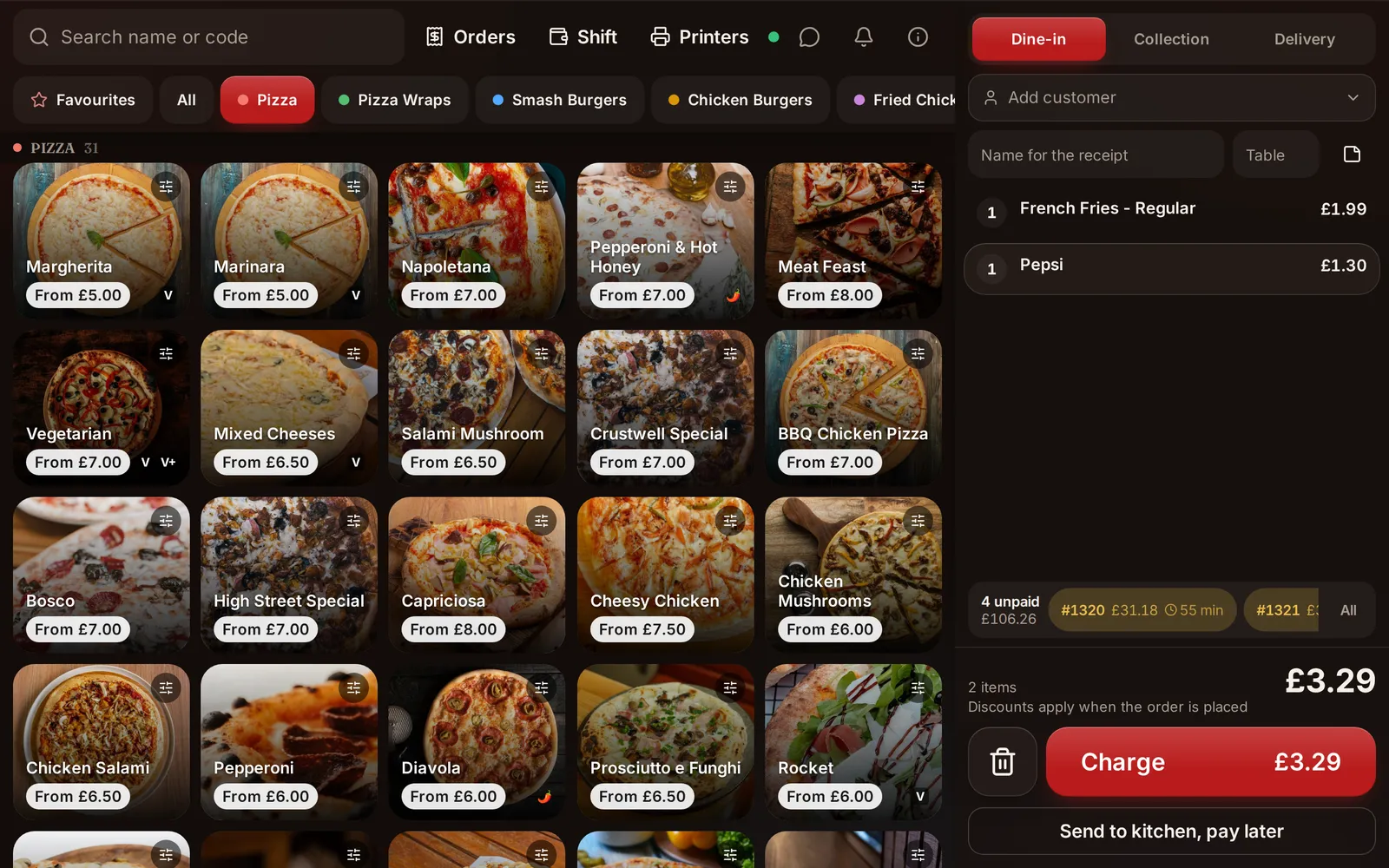
Use the same sheet, in the same order, every day. Whatever till you use, get the day's sales from the system and compare them with what is physically in the drawer. DineHarbor's POS takes sales and payments at the till and its reports show your sales by day; look at what your own reports show before you design the routine.
When the till is out
Follow a fixed checklist before you form a view:
- Recount the cash, slowly.
- Check the arithmetic of the expected figure: float, cash sales, paid outs, refunds.
- Look at paid outs and whether a receipt was lost.
- Look at voids, refunds and discounts for the shift.
- Check tenders: was a card sale rung as cash or the other way?
- Ask who used the drawer, and ask for their recollection openly.
- Check the safe and the drop log for an unrecorded drop.
- Write down the difference and the cause or "cause not found".
Many restaurants set a tolerance, for example "differences under a small amount are written down but not investigated". Choose your own, and always record it. The pattern is what matters: a difference of the same size every Thursday points to a process or a person, and a random mix of small plus and minus differences points to counting or change.
Controls that protect honest staff
Good controls make honesty easy and mistakes visible:
- Separate duties: the person who counts is not the person who banks, and the person who banks is not the person who reconciles the bank statement.
- Dual control for the safe and for counts above a set amount.
- Daily review by a manager of voids, refunds, discounts and paid outs. A few minutes a day catches problems early.
- Surprise counts of a drawer in the middle of a shift now and then.
- Banking routine: bank often, in sealed bags with a slip, and keep the slip.
- Cameras only where the law allows, with clear notices. Data protection rules apply to staff and guests.
- Fewer cash handlers: the fewer hands, the clearer the trail. Many restaurants encourage card or contactless payment, which also lowers the cash they hold. See card payment fees for the cost trade off.
- A written policy that all staff read and sign, covering floats, drops, paid outs, refunds and what happens when the count is out. Put it in the onboarding checklist.
Tips and cash
Tips, service charge and cash are linked. A tip jar, a service charge pool and a cash drawer each need their own record and rules. See tips and service charges.
Records
Your sales and cash records feed your accounts and your tax return. Rules vary by country and by business type. In the UK, GOV.UK says sole traders and partners must keep records of business income and expenses for their Self Assessment tax return, and that limited companies have different rules. For how long and in what form, ask your accountant or your tax authority.
A practical minimum is: the end of shift report, the cash up sheet, the paid out log with receipts, the bank slips and a monthly reconciliation of the bank statement. See accounting basics and VAT and sales tax.
Robbery and safety
Cash attracts risk. Keep the amount on the premises low, vary the time and route of bank runs, never carry cash alone at night if you can avoid it and train staff to hand over money and stay safe if threatened: no heroics. Your local police crime prevention team can advise on your premises. See first aid and fire safety for a wider safety plan.
Common mistakes
- Sharing one drawer between several people.
- Paying suppliers from the till without a receipt.
- Counting without a second person and without writing the count.
- Leaving a large amount of cash in the drawer overnight.
- Chasing individuals before checking the process.
- Setting no tolerance and no routine, so every difference feels like a crisis.
- Never reviewing the voids and refunds report.
A checklist
- One drawer per person, one sign in per person.
- A fixed float counted in and out.
- Drops to a safe and a written paid out log.
- A cash up sheet, in the same order, every night.
- A fixed checklist for differences.
- Daily review of voids, refunds and discounts.
- Separate duties and dual control.
- Records kept as your accountant advises.
Sources
- GOV.UK, Business record keeping for sole traders and partners, as of October 2026 (what it says about sole traders, partners and limited companies).
- Your national tax authority and your accountant for the records and retention periods that apply to you.
Want your daily takings, voids and refunds in one view? Start the 30 day free trial with no card needed.
Questions and answers
What is a normal till difference?
There is no universal figure. Some small differences happen when coins are mixed up or change is given wrongly. Set your own tolerance from your history, and look at patterns over weeks rather than one night.
What should I do if the till is short?
Recount, check paid outs, voids and refunds, compare card slips with the sales report, ask who used the drawer, and write down the result. Do not accuse anyone on the night; look for the process cause first.
Should staff pay back shortages?
Employment law on deductions differs by country and contract, and in many places deductions from pay are restricted. Take advice before you do this, and consider fixing the process instead.
How long must I keep cash records?
It depends on your country and your business type. In the UK, sole traders and partners must keep records of income and expenses for Self Assessment, and limited companies have different rules. Ask your accountant for the period that applies to you.
How do I reduce cash risk?
Use one drawer per person, make regular drops to a safe, count in pairs, keep a written paid out log, bank often and move more guests to card payment where that suits you.
See it in DineHarbor
About the author
Editorial team
The DineHarbor team writes this blog for restaurant owners and managers. Every article is checked against the product before it is published, so what we describe is what the software does.
All articles by DineHarbor team
